ASSETs+ Strategy for developing Skills and Competences in the Defence Sector
The ASSETs+ Strategy for developing Skills and Competences in the Defence Sector, based on current EU policies and EDSP European Defence Skills Strategy (2020‐2024), contributes with 37 actions that aim at facing technological evolution and socio-economic transformations, building a sustainable qualified human resources supply, providing companies working in Defence access to qualified professionals, and boosting the European Defence system towards sovereignty and autonomy.
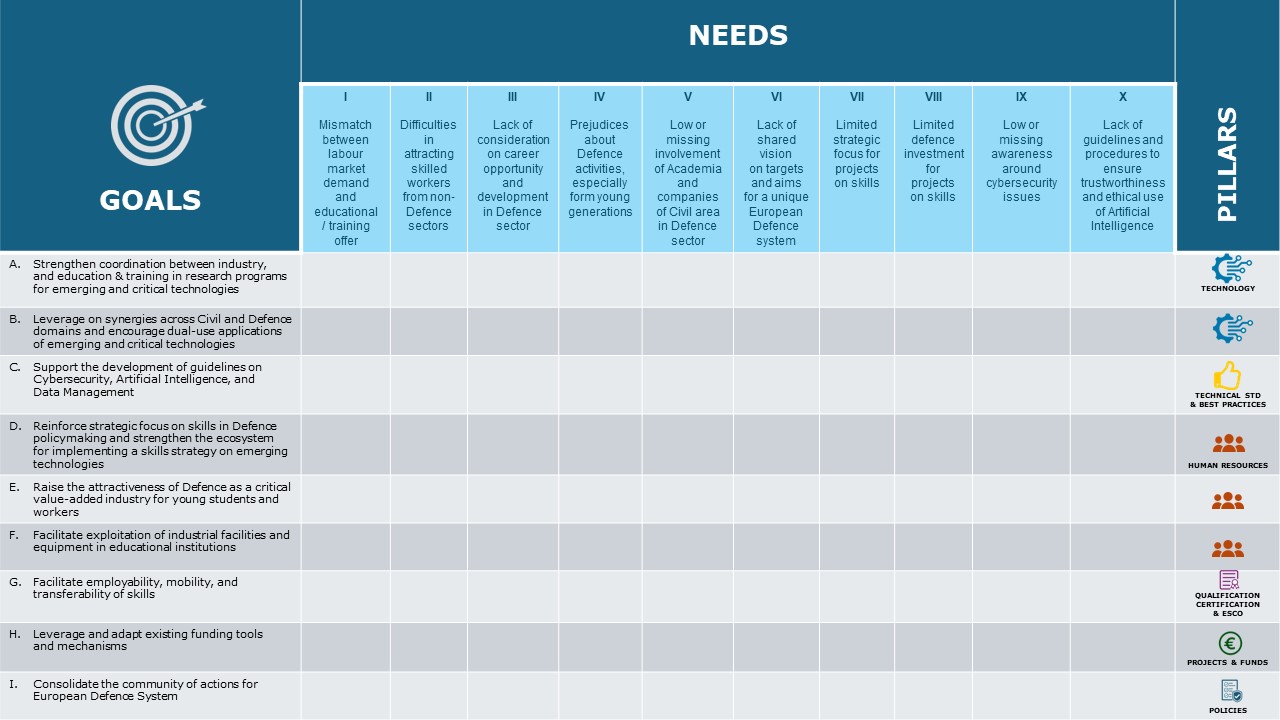
These actions refer to different operative areas, named as pillars. The implementation of the actions can contribute to reach one or more goals, fulfilling one or more needs of EU Defence Sector. The links between actions, pillars, goals, and needs are reported in the following Table.
The actions were evaluated according two features, i.e., cost and impact, for prioritizing their implementation.
- The COST measures the economic cost for the implementation, the availability of infrastructure, and the effort for implementation (e.g., Are new policies and/or regulations needed? Are the required capabilities available?).
- The IMPACT evaluates the contribution of the given action in realizing the ASSETs+ vision, i.e. “Improve human resource supply chains in the Defence sector, so that graduates will have the right skills for the market and the existing workforce will have reskilling and upskilling opportunities”.
This evaluation ranks the actions in four priority categories: (1) Challenges, (2) Wills, (3) Options, and (4) Hurdles, as reported in the following collapsible panes below the table.
Click on the hotspots in the table for discovering actions based on their contributions towards goals and needs for the Defence Sector:
Open the collapsible panes for exploring actions based on prioritization:
CHALLENGES: high cost and high impact, actions to purse to obtain a great contribution towards the goals.
ACTIONS:
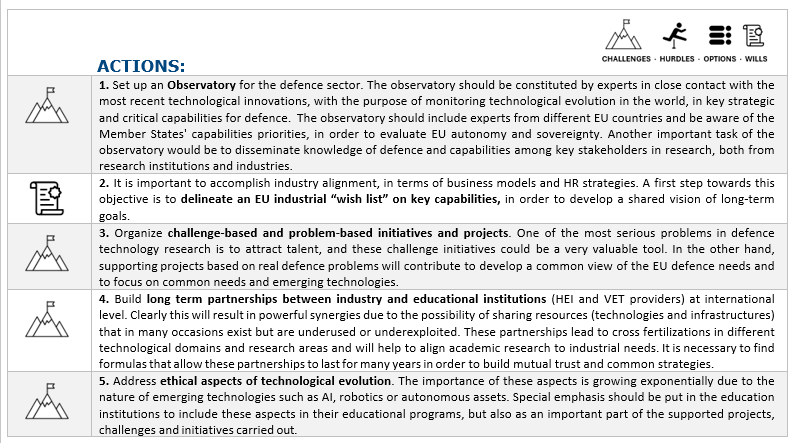
1. Include in the set-up of a Defence skills Observatory experts in new technological advancements who could support monitoring technological developments relevant for the defence sector. Including experts from different technology domains and different EU member states may support having a more comprehensive overview. The observatory needs foresee activities supporting the dissemination of knowledge of new and emerging technologies relevant for defence to key stakeholders from research institutions and industries.
3. Organize challenge-based and problem-based initiatives and projects to attract talent to work in defence industry. Projects based on real problems identified in defence industry can contribute also to developing a common view of the existing issues and agree on emerging skill needs.
4. Build long term partnerships between industry and education and training providers at both HE and VET level and to facilitate their collaboration at international level. This will facilitate sharing resources (technologies and infrastructures) that on many occasions exist but are underused or underexploited. Such partnerships may lead to cross fertilizations in different technological domains and research areas and help to align better academic research to industrial needs. It is necessary to work on tools that would allow successful partnerships to transform into sustainable long-term collaboration.
5. Address ethical aspects of technological evolution. The importance of these aspects is growing exponentially due to the nature of emerging technologies such as AI, robotics or autonomous assets. Special emphasis should be put in the education institutions to include these aspects in their educational programs, but also as an important part of the supported projects, challenges and initiatives carried out.
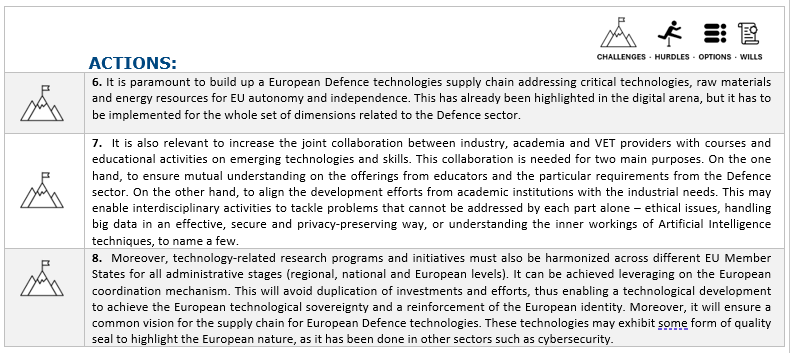
6. It is paramount to build up a European Defence technologies supply chain addressing critical technologies, raw materials and energy resources for EU autonomy and independence. This has already been highlighted in the digital arena, but it has to be implemented for the whole set of dimensions related to the Defence sector.
7. Increase joint collaboration between industry, HE and VET providers in developing and providing courses and educational activities on emerging technologies. This would facilitate mutual understanding about the training offers from educators and the training needs and training requirements from the Defence sector. This may enable interdisciplinary activities to tackle problems that cannot be addressed by each part alone – ethical issues, handling big data in an effective, secure and privacy-preserving way, or understanding the inner workings of Artificial Intelligence techniques, to name a few.
8. Facilitate understanding and access to relevant EU programmes and incentives that support technology related research and skills building incentives and contribute to harmonizing technology related research programmes and initiatives across different EU Member States for all administrative stages (regional, national and European levels). These can avoid duplication of investments and efforts, thus enabling a technological development to achieve the European technological sovereignty and a reinforcement of the European identity. Moreover, it will ensure a common vision for the supply chain for European Defence technologies. These technologies may exhibit some form of quality seal to highlight the European nature, as it has been done in other sectors such as cybersecurity.
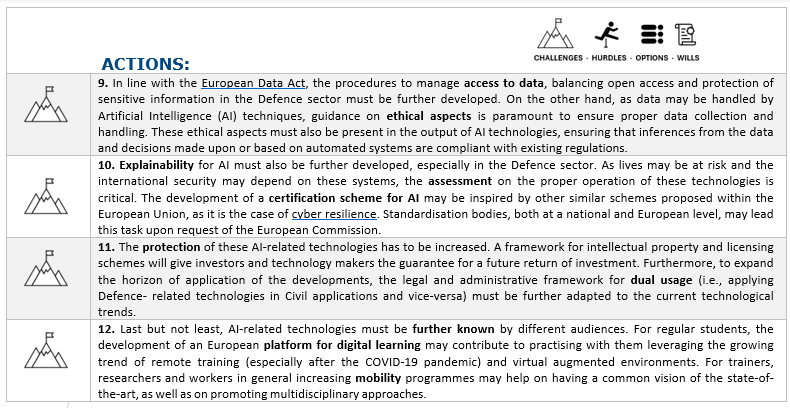
9. Develop common procedures addressing the issues linked to data access in the defence industry. In line with the European Data Act, the procedures to manage access to data, balancing open access and protection of sensitive information in the Defence sector must be further developed. On the other hand, as data may be handled by Artificial Intelligence (AI) techniques, guidance on ethical aspects is paramount to ensure proper data collection and handling. These ethical aspects must also be present in the output of AI technologies, ensuring that inferences from the data and decisions made upon or based on automated systems are compliant with existing regulations.
10. Develop a certification scheme for AI. Explainability for AI must also be further developed, especially in the Defence sector. As lives may be at risk and the international security may depend on these systems, the assessment on the proper operation of these technologies is critical. The development of a certification scheme for AI may be inspired by other similar schemes proposed within the European Union, as it is the case of cyber resilience. Standardisation bodies, both at a national and European level, may lead this task upon request of the European Commission.
11. Promote and protect the exploitation of emerging technologies. The protection of these AI-related technologies must be increased. A framework for intellectual property and licensing schemes will give investors and technology makers the guarantee for a future return of investment. Furthermore, to expand the horizon of application of the developments, the legal and administrative framework for dual usage (i.e., applying Defence-related technologies in Civil applications and vice-versa) must be further adapted to the current technological trends.
12. Develop a European platform for digital learning focused on new and emerging technologies. This can enhance knowledge sharing among educational providers and researchers across Europe. Moreover, for regular students, the development of a European platform for digital learning may contribute to practising with them leveraging the growing trend of remote education (especially after the COVID-19 pandemic) and virtual augmented environments. For trainers, researchers and workers in general increasing mobility programmes may help on having a common vision of the state-of-the-art, as well as on promoting multidisciplinary approaches.
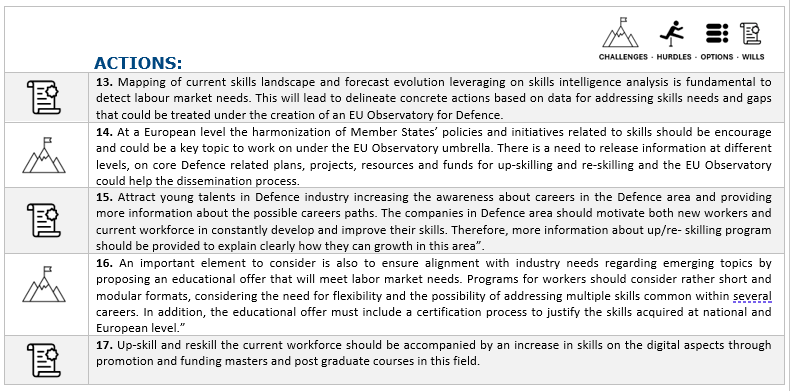
14. Facilitate collaboration for Defence related initiatives and issues among EU members states. At a European level the harmonization of Member States’ policies and initiatives related to skills should be encourage and could be a key topic to work on under the EU Observatory umbrella. There is a need to release information at different levels, on core Defence related plans, projects, resources and funds for up-skilling and re-skilling and the EU Observatory could help the dissemination process.
16. Develop a tailored training offer in the form of short modules addressing the upskilling and reskilling needs of the defence industry in close collaboration with the industry. An important element to consider is also to ensure alignment with industry needs regarding emerging topics by proposing an educational offer that will meet labor market needs. Programs for workers should consider rather short and modular formats, considering the need for flexibility and the possibility of addressing multiple skills common within several careers. In addition, the educational offer must include a certification process to justify the skills acquired at national and European level.
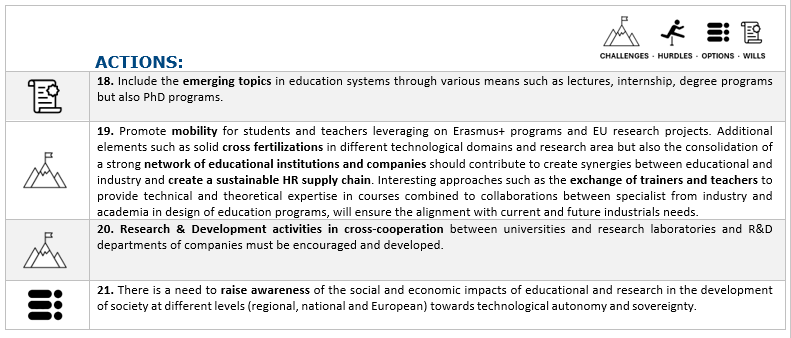
19. Promote mobility for students and teachers leveraging on Erasmus+ programs and EU research projects. Additional elements such as solid cross fertilizations in different technological domains and research area but also the consolidation of a strong network of educational institutions and companies should contribute to create synergies between educational and industry and create a sustainable HR supply chain. Interesting approaches such as the exchange of trainers and teachers to provide technical and theoretical expertise in courses combined to collaborations between specialist from industry and academia in design of education programs, will ensure the alignment with current and future industrials needs.
20. Encourage Research & Development activities in cross-cooperation between universities and research laboratories and R&D departments of companies.
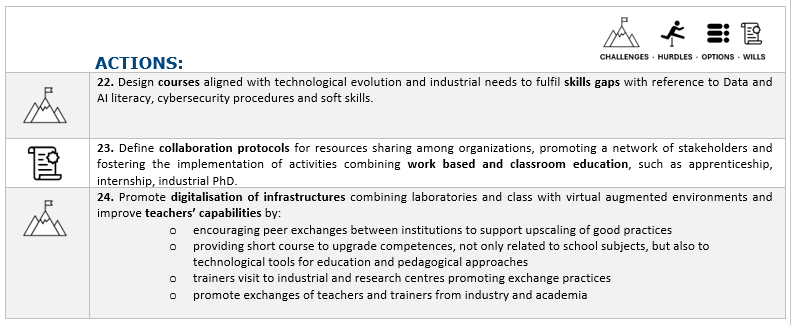
22. Design courses aligned with technological evolution and industrial needs to fulfil skills gaps with reference to Data and AI literacy, cybersecurity procedures and soft skills.
24. Promote digitalisation of infrastructures combining laboratories and class with virtual augmented environments and improve teachers’ capabilities by:
• encouraging peer exchanges between institutions to support upscaling of good practices
• promote exchanges of teachers and trainers from industry and academia
• providing short course to upgrade competences, not only related to school subjects, but also to technological tools for education and pedagogical approaches
• trainers visit to industrial and research centres promoting exchange practices
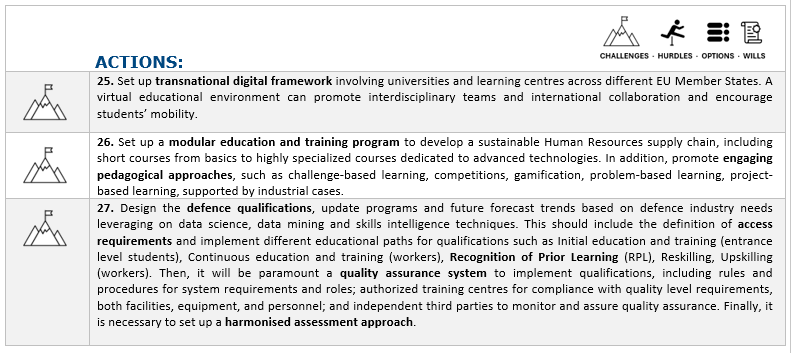
25. Set up transnational digital framework involving universities and learning centres across different EU Member States. A virtual educational environment can promote interdisciplinary teams and international collaboration and encourage students’ mobility.
26. Set up a modular education and training program to develop a sustainable Human Resources supply chain, including short courses from basics to highly specialized courses dedicated to advanced technologies. In addition, promote engaging pedagogical approaches, such as challenge-based learning, competitions, gamification, problem-based learning, project-based learning, supported by industrial cases.
27. Design the defence qualifications, update programs and future forecast trends based on defence industry needs leveraging on data science, data mining and skills intelligence techniques. This should include the definition of access requirements and implement different educational paths for qualifications such as Initial education and training (entrance level students), Continuous education and training (workers), Recognition of Prior Learning (RPL), Reskilling, Upskilling (workers). Then, it will be paramount a quality assurance system to implement qualifications, including rules and procedures for system requirements and roles; authorized training centres for compliance with quality level requirements, both facilities, equipment, and personnel; and independent third parties to monitor and assure quality assurance. Finally, it is necessary to set up a harmonised assessment approach.
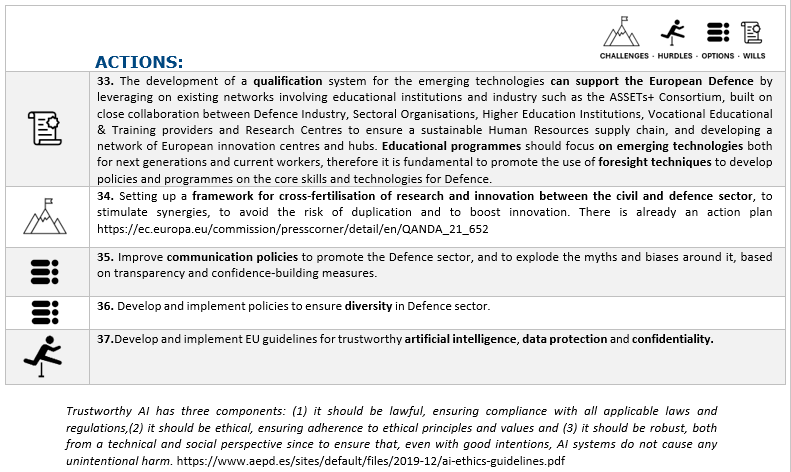
34. Set up a framework for cross-fertilisation of research and innovation between the civil and defence sector, to stimulate synergies, to avoid the risk of duplication and to boost innovation. There is already an action plan https://ec.europa.eu/commission/presscorner/detail/en/QANDA_21_652
WILLS: low cost and high impact, actions that can be easily implemented leading to a great contribution towards the goals.
ACTIONS:
2. Delineate an EU industrial “wish list” on key capabilities to keep the alignment among industrial needs, business models and HR strategies.
13. Map and keep updated skills landscape for the defence sector and develop quality technology and skills intelligence analysis capturing the need of the labour market. This will lead to delineate concrete actions based on data for addressing skills needs and gaps. The skills Observatory for Defence could lead this task
15. Support attracting young talents to work in Defence industry by increasing the awareness about careers in the Defence area and providing more information about the possible careers paths. The companies in Defence area should motivate both new workers and current workforce in constantly develop and improve their skills. Therefore, more information about up/re-skilling program should be provided to explain clearly how they can growth in this area.
17. Mapping the educational and training offer to Identify and promote already existing training offer focusing on up-skilling and reskilling the current workforce. Increase awareness and expertise in skills on the digital aspects through promotion and funding masters and post graduate courses in this field.
18. Promote Including the emerging topics in education systems through various means such as lectures, internship, degree programs but also PhD programs.
23. Define collaboration protocols for resources sharing among organizations, promoting a network of stakeholders and fostering the implementation of activities combining work based and classroom education, such as apprenticeship, internship, industrial PhD.
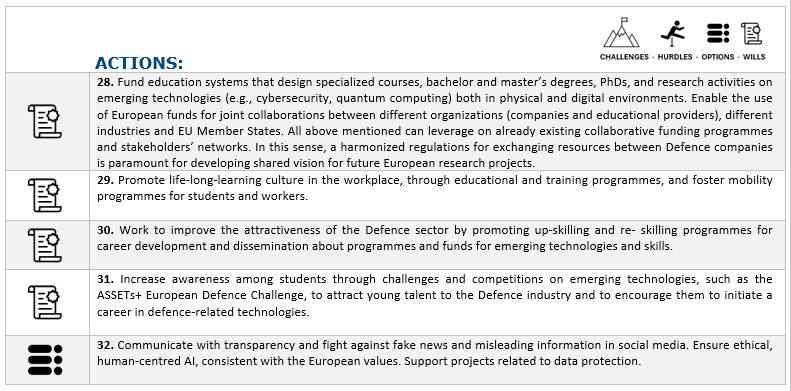
28. Identify and promote EU funding opportunities for joint collaborations between different organizations (companies and educational providers), different industries and EU Member States. All above mentioned can leverage on already existing collaborative funding programmes and stakeholders’ networks. In this sense, a harmonized regulations for exchanging resources between Defence companies is paramount for developing shared vision for future European research projects.
29. Promote life-long-learning culture in the workplace in Defence industry, through educational and training programmes, and foster mobility programmes for students and workers.
31. Increase awareness among students through challenges and competitions on emerging technologies, such as the ASSETs+ European Defence Challenge, to attract young talent to the Defence industry and to encourage them to initiate a career in defence-related technologies.
30. Work to improve the attractiveness of the Defence sector by promoting up-skilling and re-skilling programmes for career development and dissemination about programmes and funds for emerging technologies and skills.
33. Develop a qualification system for the emerging technologies that can support the European Defence by leveraging on existing networks involving educational institutions and industry such as the ASSETs+ Consortium, built on close collaboration between Defence Industry, Sectoral Organisations, Higher Education Institutions, Vocational Educational & Training providers and Research Centres to ensure a sustainable Human Resources supply chain, and developing a network of European innovation centres and hubs. Educational programmes should focus on emerging technologies both for next generations and current workers, therefore it is fundamental to promote the use of foresight techniques to develop policies and programmes on the core skills and technologies for Defence.
OPTIONS: low cost and low impact, actions that may not produce a great contribution towards the goals but can be implemented without a great effort.
ACTIONS:
21. Implement awareness raising activities on the social and economic impacts of educational and research in the development of society at different levels (regional, national and European) towards technological autonomy and sovereignty.
32. Communicate with transparency and fight against fake news and misleading information in social media. Ensure ethical, human-centred AI, consistent with the European values. Support projects related to data protection.
35. Improve communication policies to promote the Defence sector, and to explode the myths and biases around it, based on transparency and confidence-building measures.
36. Develop and implement policies to ensure diversity in Defence sector.
HURDLES: high cost and low impact, actions that require a great effort without ensuring a great contribution towards the goals.
ACTIONS:
37. Develop and implement EU guidelines for trustworthy artificial intelligence, data protection and confidentiality.